
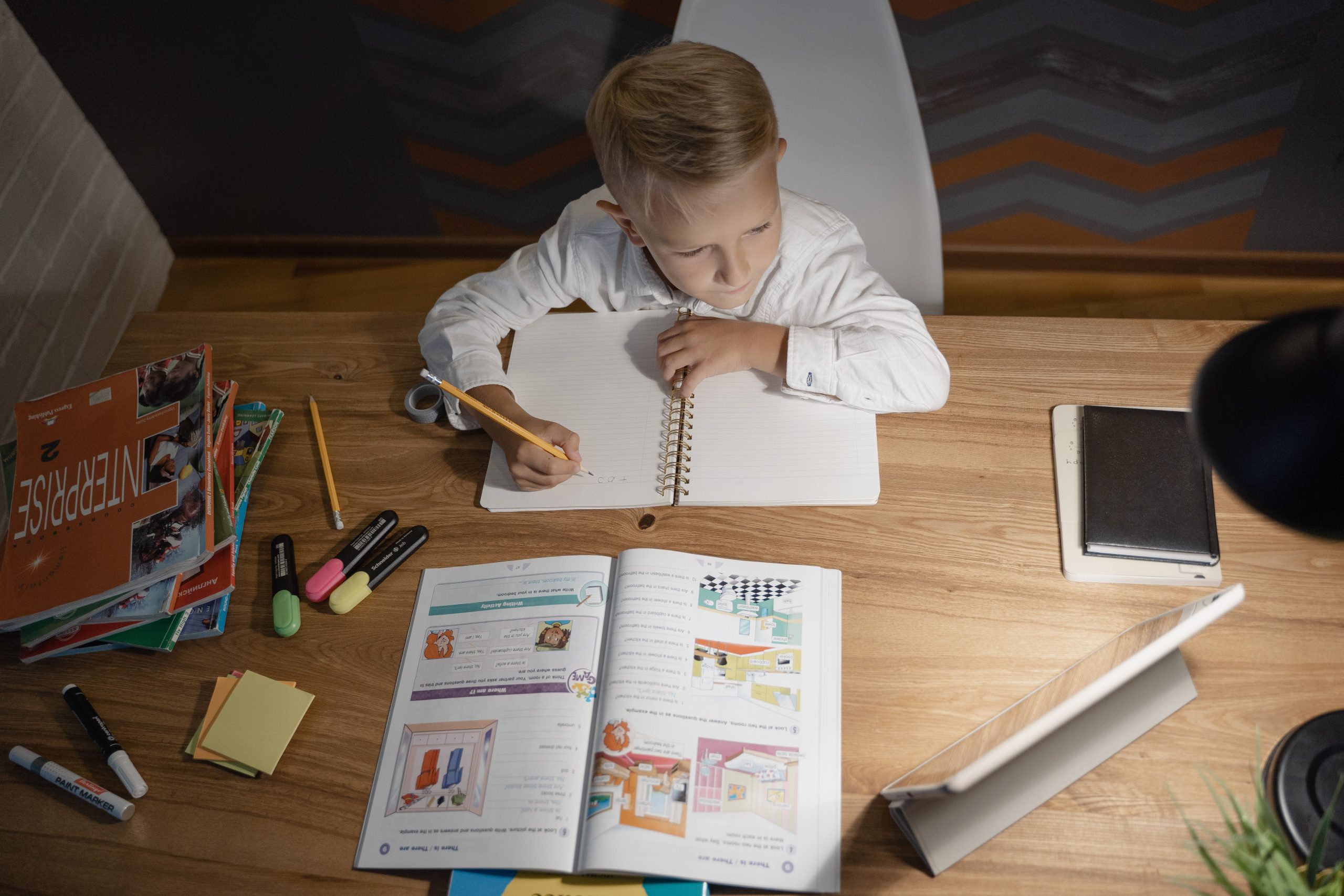
One of the first questions new homeschool families ask — and one of the easiest to overcomplicate — is what a homeschool space should look like. Pinterest boards and homeschool influencers tend to show beautifully organized dedicated rooms with built-in shelving, labeled bins, and coordinated everything. The reality is that most successful homeschool families don’t have that, and it’s entirely unnecessary.
What a homeschool space genuinely needs to accomplish is more modest: provide a consistent environment where children can focus, where materials are accessible without a prolonged search, and where the parent can teach and work without fighting constant environmental friction. That’s achievable in a dedicated room, a section of a kitchen table, or anything in between.
The Dedicated Room Question
The first thing to settle is whether a dedicated homeschool room is necessary at all. It isn’t — and for many families, it isn’t practical.
Many homeschool families conduct school at the kitchen or dining table, with materials stored in a nearby cabinet, closet, or rolling cart. This approach works well because it puts school in the center of the home’s activity rather than isolated in a separate space, which suits younger children in particular. The tradeoff is that school materials need to be set up and put away each day, and the space isn’t exclusively dedicated to school.
Families who do have a dedicated room — a spare bedroom, a finished basement, a converted garage space — gain the advantage of a permanent setup that doesn’t need to be cleared for meals or other activities, and a space that signals to children that school is happening. The tradeoff is that not every family has a room to dedicate, and even those who do sometimes find their children gravitate toward the kitchen table anyway.
Neither approach is inherently better. The question worth asking is: what space is consistently available during school hours, and what setup will actually be maintained over the long run — not what looks best as an ideal scenario?
What the Space Actually Needs
Regardless of whether a dedicated room or a shared space is the answer, a few consistent elements tend to make a homeschool space work better.
A workspace for each child that minimizes distractions. This doesn’t require desks — a section of a table works. What matters more is that the workspace itself isn’t covered in unrelated items during school time, and that obvious distractions — screens, toys, non-school items — aren’t in the immediate line of sight or reach during work periods.
Accessible, organized storage for current materials. The difference between a functional homeschool setup and a frustrating one often comes down to whether the materials needed for each day can be found and retrieved in thirty seconds or less. This doesn’t require elaborate shelving systems — it requires consistency about where things live. A few shelves, a rolling cart, or a well-organized closet all accomplish the same goal.
Good lighting. Natural light is ideal. Adequate artificial light where natural light isn’t available is a close second. Poor lighting causes fatigue faster, particularly for reading-intensive work.
Comfortable working conditions for the type of work being done. Seated seatwork benefits from an appropriate chair height. Floor-based or hands-on activities need accessible floor space. A standing option — a counter or a high table — is worth considering for children who work better while standing, which is more common than it’s sometimes assumed.
A reference-accessible wall space. A section of wall visible from the workspace for an alphabet chart, a number line, a world map, a timeline, or whatever reference materials are regularly used saves the constant searching that happens when reference materials are stored away in a folder or book.

Ready to bring order to your homeschool?
Join homeschool families who traded binders and spreadsheets for a planner that actually keeps up with them. Start your free 14-day trial today.
14-day free trial · Cancel any time
What the Space Doesn’t Need
Equally important as what a homeschool space needs is what it doesn’t need — because new homeschool families frequently spend significant time and money on things that turn out not to matter.
An extensive book collection before knowing what will actually be used. Many new homeschool families acquire large numbers of books early, based on recommendations or enthusiasm, and discover that a meaningful portion of those books doesn’t fit their child’s interests, learning style, or the curriculum direction they end up going. Building a library gradually, based on what’s actually working, tends to produce a more useful and less cluttered collection than buying widely at the start.
Elaborate organizational systems that require significant maintenance. A labeling and filing system that’s too time-consuming to maintain consistently will be abandoned within a few weeks, leaving materials in a worse state of organization than a simpler system would have. The right level of organization is the level that can be sustained on an average day, not the level that works only when someone is actively reorganizing.
Dedicated desks for every child, especially young children. Young children, particularly those under eight, often don’t want to sit at a desk for extended periods — and developmentally, there’s no strong reason they should. Many families find that flexible seating options — a table, floor space, a couch for read-alouds, a kitchen counter — serve younger children better than a small desk that they frequently abandon.
A complete setup before starting. Starting with what’s available and adding to it based on what’s actually missing is a more efficient approach than waiting until everything is perfect or purchasing everything imaginable in advance. The gaps in a setup reveal themselves quickly once school is underway, and filling actual gaps is more targeted than trying to anticipate all possible needs before the first day.
Organizing Materials for Daily Use
The materials management challenge in homeschooling is ongoing — curricula accumulate, completed work needs to be stored or filed, and the active materials for the current week need to be accessible without sorting through everything else.
A simple tiered approach tends to work well: active current materials within immediate reach, materials for the current term accessible nearby, and older completed work or future materials stored further away or in longer-term storage.
For daily materials, a student binder or folder containing current assignments, reference sheets, and in-progress work keeps the day’s needs in one portable location, reducing setup time at the start of each school day.
For current curriculum materials, a shelf or cart within arm’s reach of the workspace means retrieval is quick and returning materials after use is low-friction enough to actually happen.
For completed student work, a simple accordion file or a series of folders — one per subject, or one per month — makes it possible to locate past work quickly when it’s needed for a portfolio, transcript, or assessment without sorting through everything accumulated over a year.
For future or archived materials, a closet, a storage bin, or a different room entirely reduces the clutter in the active workspace without discarding materials that might be used later or by a younger sibling.
Technology in the Homeschool Space
Whether and how technology fits into a homeschool space is a decision each family makes based on their curriculum choices, their children’s ages, and their own preferences. A few practical considerations worth thinking through:
Dedicated use versus shared devices. A device used exclusively for school has clearer boundaries around its use and typically has apps, content, and settings configured for school purposes. A shared family device requires more active management of how it’s used during school time.
Screen placement relative to the workspace. A computer or tablet used for school content is most useful when positioned as a natural part of the workspace — visible and accessible without being the default distraction it becomes when it’s always in sight during non-screen work.
Printing access. Many homeschool curricula and supplementary resources rely on printable worksheets, maps, and activities. Having printer access without significant friction — meaning the printer works reliably and is in a location where printing doesn’t interrupt the flow of the school day — saves more time over the course of a year than it might initially seem.
The Space Evolves With the Family
A homeschool space that works well for a family with young children may need significant adjustment as those children grow. The reference charts needed by a first grader aren’t the same ones needed by a middle schooler. The independent work a ten year old can sustain allows for different space arrangements than the constant supervision a five year old requires. Storage needs change as curricula shift and completed work accumulates.
Approaching the homeschool space as something that evolves rather than something to set up once and never revisit tends to produce a more functional environment over time. A brief annual look at what’s working, what’s not, and what’s changed about the family’s needs guides incremental improvements without requiring a complete overhaul.
The Bottom Line
A functional homeschool space needs to provide a consistent, distraction-minimized workspace, accessible organized storage for current materials, and good lighting. Beyond that, what works best depends on the specific family, the specific children, and the specific home — not on replicating what looks appealing on social media or what works for another family in a different situation.
Starting with what’s available, adding based on what’s actually missing, and letting the space evolve as the family’s needs change is a more practical path to a genuinely functional homeschool environment than trying to build the perfect setup before school starts.